Precision Machining Services
CNC Cutting
CNC Milling
CNC Turning
CNC Routing
Shearing
Equipment
FPI Industries offers a diverse aray of machining capabilities.
Order routing through the facility is fully customized to meet each customer's specific requirements.
About Precision Machining
Traditionally, conventional machining tactics are employed to produce either low-quantity or prototype products at the most competitive prices. When production quantities are high or tolerance requirements are extremely tight, state-of-the-art CNC machining methods are used.
The industry's leading technology is not enough for success in the market. Time is the critical factor in the plant, and exact planning of its use is the fundamental instrument for ensuring the maximum efficiency of each and every project.
The machining group at FPI is comprised of technically proficient individuals and conscientious machinists. Each of these individuals understands that accurate coordination, comprehension, and communication of order data and shop floor conditions are crucial in achieving superior quality and production times.
Custom CNC Machining Services
CNC Cutting
The heart of any fabrication facility is the saw room. Providing capabilities unmatched in the industry, modern technology and equipment define FPI's cutting machinery. Often it is our vendors, lacking the means, who utilize the state-of-the-art saw resources of FPI to trim oversized sheets or oversized thickness.
CNC Milling
Unique challenges are faced with the milling of both Thermoset and Thermoplastic materials. Although Thermosets are dimensionally stable, they are extremely abrasive toward standard tooling and create dust situations.
Thermoplastics, on the other hand, may develop machined-in stress which could lead to premature part failure. In some cases, Thermoplastic parts may require annealing after machining.
CNC Turning
Special consideration is required for the turning of plastic materials. Aside from the run characteristics of these materials, additional problems concerning tolerances, coolants, and chip removal must be addressed. Over the years, FPI Industries has worked with industry engineers and tooling specialists to solve these problems.
CNC Routing
Glass fibers as woven fabrics or mats produce the highest-strength laminates. They also have superior electrical properties (maintained under high temperature and humid conditions) and high temperature resistance. Resin systems include phenolic, melamine, silicone, and epoxy.
Many variations of high pressure laminates have been standardized, resulting in the establishment of more than 70 standard grades of laminates.
If more than one standard grade possesses the required properties, final decisions can be made by considering the most suitable form and by analyzing the economic aspects relating to that laminate grade and its machinability.
Shearing
FPI Industries Equipment
These laminates are composed of glass mat and/or glass roving fibers impregnated with polyester resins. They are molded under moderate pressure or are pultruded through a die that determines their shape. Generally, the color range for laminates in basic sheet form is cream to beige, red, and light brown.
Saw Room
SCM Group Sigma Impact
TigerStop auto feeding saw
Multiple table saws
Turning Centers
Haas SL20 with bar feeder
Haas ST25Y with live tooling
Haas TL3
Haas TL1
Machining Centers
Haas Gantry GR510
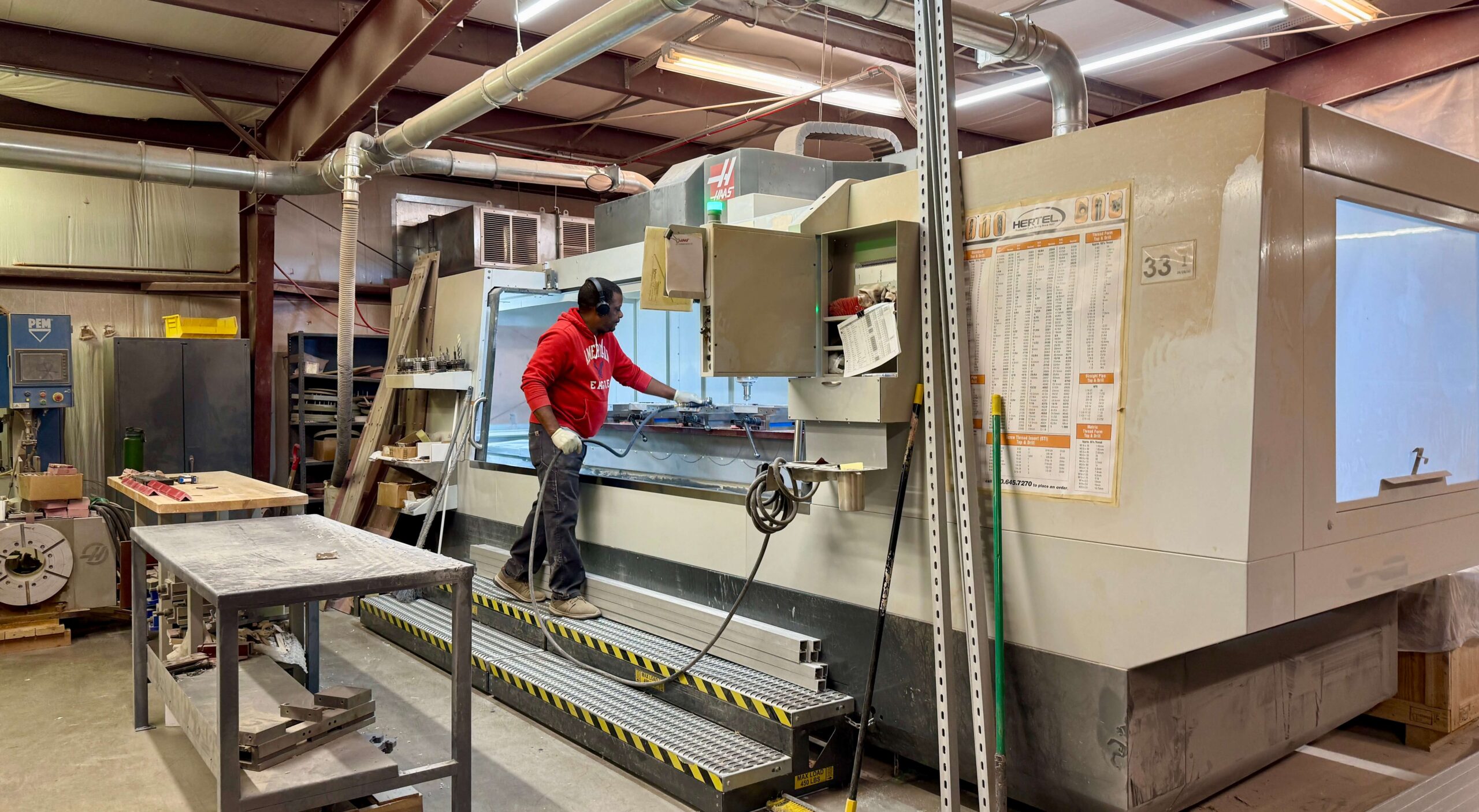
(2) Haas VF10
(3) Haas VF4
(2) Haas VF3
Haas TM3
(2) Bridgeport Series I manual mill
H1000 1130 NYCTA material
Haysite Grade 1000 laminate sheet is an outstanding material that is used in applications requiring exceptional weather and corrosion resistance. Grade H1000's unique polyester resin system provides corrosion resistance in sunlight and harsh weather environments in addition to meeting NEMA GPO-3 specifications for track resistance, flame retardance, heat resistance and physical properties. H1000 is particularly qualified for applications in the transportation industry due to its' low smoke generation, low smoke toxicity & halogen-free flame retardants. H1000 meets the rigid New York City Transit - Specification #64. Transit Authorities use Grade H1000 under their 3rd rail ties to provide electrical insulation, corrosion protection, UV resistance & most importantly to insure low smoke/flame toxicity in case of electrical failure. H1000, in a pultruded profile shape is used for electrical insulation for electrical cables, conduit & 3rd rail protection for workers.
Aside from the stock sheet sizes listed above, polyester glass is also supplied in profile shapes to meet any number of electrical and structural requirements.
They can be molded or pultruded into angle, channel, I-beam, rod and tube configurations.
Typically, these profiles are used to support and electrically isolate components in power and distribution equipment.